We can still make history: inside the £250m-a-year moonshot lab
Ilan Gur is not your classic civil servant. The cheerful Californian, wearing a T-shirt, black trainers and blue-framed glasses, looks more tech bro than government mandarin. His benefits package is also more Silicon Valley than Whitehall: £455,000 including salary, bonus and pension contributions.
But Gur, 45, does not have a classic civil service job. He is chief executive of Aria, the Advanced Research and Invention Agency, known as Britain’s “moonshot factory”.
The organisation, the brainchild of Dominic Cummings when he was in No 10, was set up in 2022 with a “high-risk, high-reward” ethos to make discoveries so monumental they would change the world.
While Cummings was a controversial figure in government, his vision has received cross-party support.
The Conservatives granted Aria an initial £800 million budget to last until this year, and last week Labour announced another £1.2 billion to cover the next four years. By 2030 Aria will receive £400 million a year.
“For us, success means not just a world-changing technology, but drastically transforming the future of the UK,” says Gur. ‘What will be our Ozempic moment?’ I meet Gur as he prepares to step down after three years at the helm of Aria. He is upbeat about his time in the UK, and — perhaps surprisingly given recent headlines about pharmaceutical companies leaving our shores — enthusiastic about the state of British science.
The typical undergraduate at a top British university, he says, “knows their field deeper than any students at MIT”. In the past, this academic strength was hampered by bureaucracy and arcane institutions, but the UK is growing in the drive and energy that it lacked in the past, Gur says. Rather than focusing on purely intellectual goals as they were in the past, British scientists today have an entrepreneurial spirit that was previously lacking, he says. “You have a critical mass of people who do want to be operating differently, who want to be more translational, more applied, more entrepreneurial in their work. It is still a subculture, but there’s a critical mass now of people who have this spirit and this ambition.”
A single breakthrough is all it would take for Aria — and the UK — to make history, Gur says. “We are asking ourselves all the time, what will be our ChatGPT moment, what will be our Ozempic moment?”
We meet at the HQ of MintNeuro, an Imperial College London spinout and one of the many start-ups and university projects Aria is funding in its attempt to develop an innovation that will transform Britain’s economy.
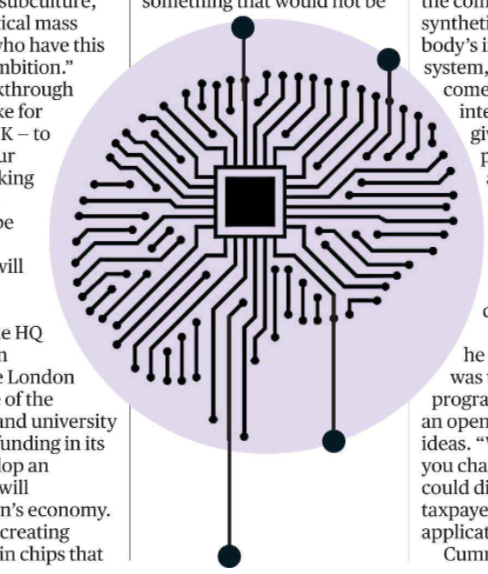
MintNeuro is creating implantable brain chips that its developers believe could revolutionise medicine. Gur says: “Recent neuroscience shows that if you look at neural circuitry and modulating across neural circuits, this could make inroads to everything from Parkinson’s, Alzheimer’s, to mood disorders to depression.”
This outfit is typical of the projects the agency funds — something that would not be out of place in the pages of a science fiction novel.
Other projects include the development of programmable plants to feed the world, robots that can rival the human hand in their performance of delicate tasks, and AI programs that can diagnose diseases before symptoms appear.
Aria teams are even working on a defence against the common cold. Using synthetic biology to tune the body’s innate immune system, Gur said, “you could come up with an intervention that would give everyone broad protection from flu and the cold and the next pandemic. It sounds ridiculous — but we’re talking about something that is that consequential.”
Gur’s first task when he took charge at Aria was to recruit eight programme directors with an open call for ambitious ideas. “We said, ‘How would you change the world if you could direct £50 million of UK taxpayer funds?’ We got 400 applications.”
Cummings, who served as chief of staff to Boris Johnson, came up with the idea of Aria when he became frustrated by the sluggish speed of British science and technology. His vision was for a new agency modelled on Darpa, the US Defence Advanced Research Projects Agency that is credited with creating the internet and GPS. Gur stressed that Cummings left government in December 2020, well before the agency was set up. “I have never met him,” he says. “But if his aspiration was for something that would be disruptive and change the opportunity landscape with technology for the future of the UK, I’d like to think that is being realised.”
The scientific establishment has also given Aria its backing. Aria’s board includes Dame Angela McLean, the government’s chief scientific adviser, and Dame Kate Bingham, who led the Covid vaccine taskforce.
Lord Vallance of Balham helped set the agency up and Sir Demis Hassabis, a Nobel prize winner and founder of Google DeepMind, is an adviser, as is Ozlem Tureci, founder of the vaccine maker BioNTech.
Robots could rival the human hand for delicate tasks
To achieve its goals Aria has been freed from the shackles of government red tape. The agency was created by an act of parliament which meant it could not be reviewed by the government for ten years, would not be subject to normal civil service pay caps, and is not subject to the Freedom of Information Act. Matt Clifford, 39, an AI entrepreneur and chair of Aria, denies that the organisation operates under a veil of secrecy. “Aria is probably the most transparent public agency of its type in the world,” he says.
Every programme document — and every draft iteration — is published on the website.
Gur earned a PhD in materials science and engineering at the University of California, Berkeley, before working on renewable energy and as an entrepreneur supporting early-stage science. When he was offered the Aria job he was advised by Silicon Valley experts that achieving success in Britain was a mammoth task.
Friends warned him that the British government would “stumble over itself setting this up and there’s no way they’re going to get it right”.
But he adds: “The government really got it right.” The act of parliament, he says, was key to giving the agency the freedom to get things done without political interference.
Clifford said the interviews for Gur’s successor had gone well. The winner is expected to be announced in the next few weeks. Clifford said a supporter had recently described Aria as “the most optimistic quarter of the UK”.
Gur agrees. “This is ... where there is an intersection of the most advanced science in the world and an entrepreneurial spirit. And that is an incredible strength for the UK.”


No comments:
Post a Comment