AI supercomputer primed for a quantum leap
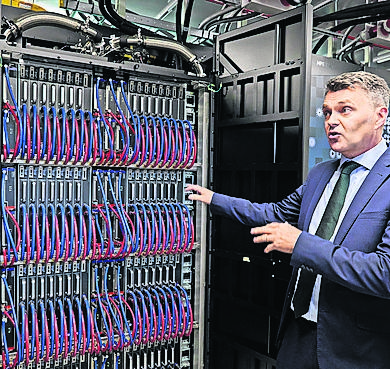
Britain’s most powerful AI supercomputer has been switched on to help the nation’s tech sector and accelerate breakthroughs in drug discovery, climate change and material science.
Isambard-AI, a £225 million taxpayer-funded facility in Bristol, is central to the government’s aim of building “sovereign” capacity in artificial intelligence.
Named after Isambard Kingdom Brunel, the engineer who designed the city’s Clifton Suspension Bridge, the supercomputer is the 11th most powerful in the world and sixth in Europe.
It has the capacity of 600,000 laptops and uses the energy of 16,000 kettles, but its cooling system means it is the world’s fourth greenest supercomputer.
Some of the energy generated at Isambard, which was built in less than a year on the site of a car park, will go towards heating local homes.
Labour recently committed itself to building a £750 million supercomputer called Archer2 at the University of Edinburgh, which will be the UK’s biggest when it goes live in 2027.
Isambard is a dedicated AI facility, together with the smaller Dawn supercomputer in Cambridge, but Archer2 will do other scientific work.
The government is planning to spend another £1 billion to expand AI-dedicated computer capacity twentyfold by 2030, having spent £350 million on the Bristol and Cambridge facilities.
Professor Simon McIntosh-Smith, director of the Bristol Centre for Supercomputing, said: “Isambard is big enough to train ChatGPT — the latest version — in the UK. We could not do that before. We would know exactly what was run, what data went into it and doing it all here. That puts us in a much safer, stronger position.”
Britain still lags behind other European countries, such as Germany, Italy, Switzerland and Finland. The US is said to be home to 75 per cent of the world’s AI supercomputers, and China second.
David Hogan, a senior executive at Nvidia, said a challenge for the UK was the price of energy. “It’s cheaper because of renewables in the Nordics, solar in Spain, and then there’s a mix in the middle,” he said. “France is fortunate because it’s stuck with nuclear. There are approaches to address that [in the UK] like small nuclear reactors.”
Isambard has piloted 60 research projects, including a ChatGPT-style large language model called BritLLM, as well as AI-driven drug discovery and advanced climate modelling.
University College London researchers are using it to develop AI imaging for prostate cancer screening and Bristol academics are designing a system to help dementia patients at home.
Jon Lees, a lecturer in bioinformatics at Bristol University, has been using the system to predict how proteins interact with each other in patients with Alzheimer’s. “It’s been huge for us and I think it’s really democratising for UK science,” he said. “It enables you to try out ideas faster. So you can sort of say ‘I’m just going to give this a go’, and you can get that preliminary data.”
Researchers will be able to apply to the Department for Science, Innovation and Technology and the funding agency UK Research and Innovation for access. Isambard, which was built by Hewlett Packard Enterprise using 5,400 GH200 chips from Nvidia, is funded for five years.


No comments:
Post a Comment